
04 · Training & certification
Hyperbaric operator training & certification
Home-user and clinical training delivered on your own chamber — in person or over video — plus IHA and IBUM provider certification packages for clinics building a hyperbaric program.
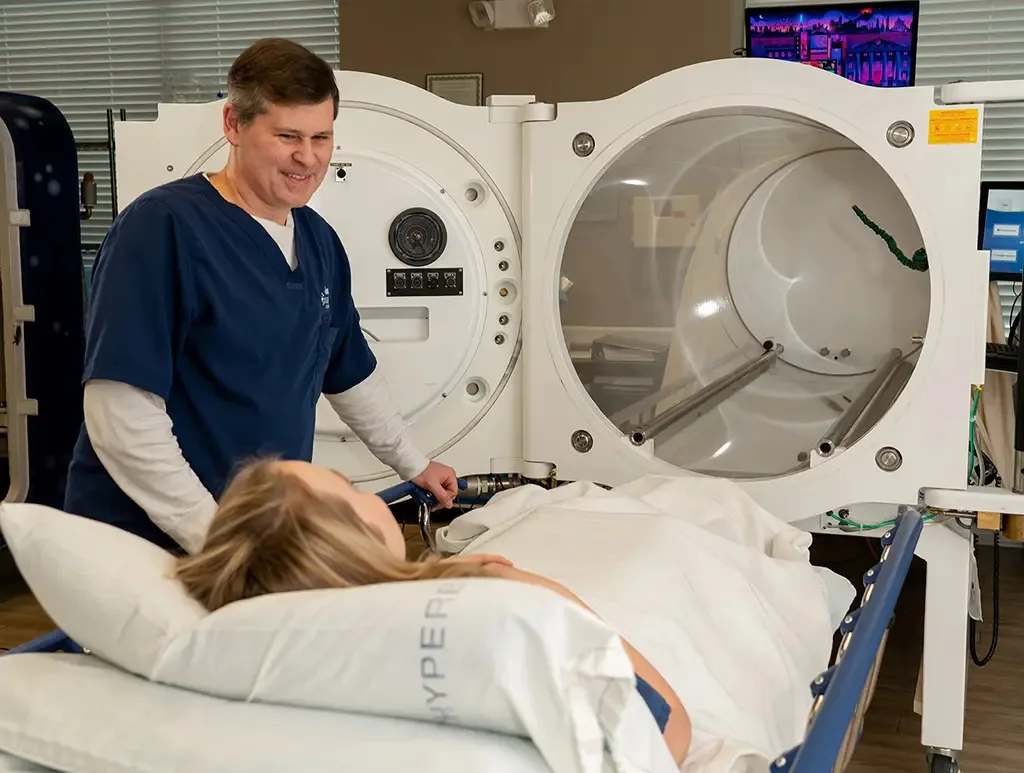
Why it matters
Most incidents are operator error, not equipment failure.
Descending too fast on someone who cannot equalize, running a session with lotion or a loose battery pack inside, taking a concentrator’s purity on faith, or opening a clamp before the chamber has fully vented — none of those are hardware problems. Training is the cheapest safety device you can buy.
Home user safety & operations training
One-to-one session on your own chamber, live over video or in person, ending with a certificate for your records. Built for owners of soft-shell mild HBOT chambers at 1.3–1.5 ATA and residential hard shells.
- Daily pre-session checks and go / no-go criteria
- Correct compression rate and coaching ear equalization to avoid barotrauma
- Zipper or pinch-clamp closure technique and what a bad seal feels like
- Cannula and non-rebreather mask fitting, and the concentrator flow you need to hold
- Oxygen fire safety — what never goes in the chamber
- Emergency depressurisation and self-egress
- The log to keep so warranty and maintenance stay valid
Clinical team training package
For clinics, wellness studios and athletic programs putting staff on a chamber every day. Delivered to the whole team, on your equipment and your room layout, with startup help for a new program.
- Client screening and contraindication questions front-desk staff must ask
- Session protocol: compression, dwell at pressure, decompression, turnaround
- Oxygen delivery by mask, hood or BIBS, and occupant comfort management
- Ambient oxygen awareness, grounding and static control in the treatment room
- Emergency procedure, egress and who does what
- Maintenance log ownership and when to call a technician
- Startup help: room setup, workflow, documentation and signage
Certification
IHA and IBUM provider certification
Two credentials matter in this field. IHA — the International Hyperbaric Association — certifies hyperbaric technicians and operators, and is the credential most mild-HBOT facilities are asked for. IBUM — the International Board of Undersea Medicine — is the clinical hyperbaric technologist route, relevant when a facility operates at higher pressures under medical supervision.
We hold both, and we broker certification for our clients rather than leaving them to work it out alone.
IHA and IBUM certifications are issued by those organisations, not by HSP. We prepare and sponsor candidates and coordinate the process; the credential itself comes from the certifying body. Safety-director responsibilities and protocols are covered in the curriculum. That is not the same as IBUM's Safety Director credential, which IBUM certifies and prices separately.
Ground rules we teach first
Oxygen fire safety, every session
An oxygen-enriched environment does not create fire, but it makes almost anything burn faster and hotter. Every operator we train learns the same non-negotiables before they touch a control.
- No petroleum products. No lotions, oils, ointments, hair products, aerosols or lip balm on the occupant or inside the shell.
- No loose electronics or batteries. Phones, vapes, e-readers, hearing aids and battery packs stay outside unless the manufacturer explicitly permits them.
- Static control. Cotton bedding and clothing, grounded chamber, no synthetic blankets brought in from home.
- Clear egress. Nothing stacked against the door or zipper. The path out stays clear for the whole session.
- Ambient oxygen awareness. Enriched air leaves the chamber with the occupant — ventilate the room and, for busy facilities, monitor ambient O₂ continuously.
- Never rush decompression. Vent at the rate the chamber and the occupant’s ears can take, and never release a clamp or zipper under pressure.
Start a work order
Tell us the chamber, the site, and the timeline.
Make, model, serial number, photos, site address — send it all in one text or email and we can scope, price or diagnose it without a round of phone tag. Complete requests get worked first, simply because they can be.